
How much platform does an emerging memoirist need?
Plus: Finding a memoir structure, Swedish Fish, and The Love Boat

To the Food Truck Cook on the Upper West Side
I’m pleased to share that I have a new flash piece up at River Teeth’s Beautiful Things on change, saying goodbye, and the passing of time. You can read it HERE.

Role Reversal
Coming up this Tuesday Jill Christman interviews me on Let’s Talk Memoir. I’ve had Jill as my guest on the show for two of her books, If This Were Fiction and The Heart Folds Early. When she asked me if anyone had ever interviewed me on my podcast and what I thought about having her do it, I was delighted. Jill’s memoir Darkroom was one of the first memoirs I read when I began my MFA and if you had told me back in 2015 that in 2026 that Jill would be interviewing me about my memoir on a memoir podcast I created, my head, as I told Jill in our interview this Tuesday, would have popped off. But, here we are, and here I am, head still attached, but barely.
Once it’s live you can tune in on your favorite podcast platform and or watch it on this Substack. This isn’t just a conversation about teaching creative nonfiction and helping to make memoirs expansive, it’s The Love Boat, Swedish Fish, and our twentysomething selves. If you love yourself some Jill Christman, hope to learn more about my approach to memoir, or want to listen to two women of a certain era cackling together, this is your episode.
Study memoir with me
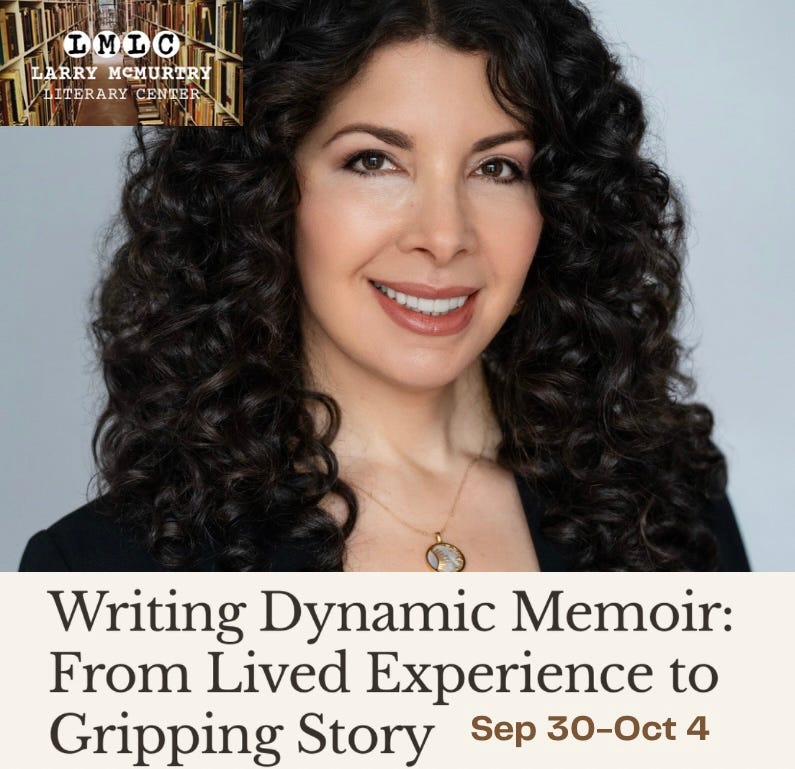
My 10-week UW Class is winding down and I’ve been having such fun with this interested, curious, and incredibly generous group of writers. What luck to have this opportunity to work with them. This 10-week class will likely be coming around again in spring 2027 but if you’d like to study memoir with me before that, I’ll be announcing a few upcoming online classes very soon, several in the summer and several in the fall. If you want to hear about these when registration goes live, subscribe to this Substack which won’t cost you a dime but keeps you in the loop. And if you’d like to workshop with me in person this fall, I’ll be at the Larry McMurtry Literary Center in Archer City Texas from 9/30-10/4. We’re going to be workshopping your writing, basking in memoir craft every day, and you’ll have opportunities to generate new writing and connect with memoir writers who are on similar creative path as you. Here’s more information and registration.
Here are two subscriber questions for this month
Question 1: Aside from working on their memoir project, what does an emerging memoirist do to get noticed, published and begin public recognition as a writer? I’m talking small publications. How important do you feel this is? - Kamile Jane Iskra
This is such a smart question and I’m happy you asked, Kamile. The issue of building a platform and getting traction with our work prior to our memoir’s publication is an important one. While I’d like to tell you not to worry about getting public recognition, that you can simply hunker down with your manuscript, doing some platform building on a consistent basis and early is strategic and will ultimately help you when you launch your book.
Adding bylines to your bio will benefit you during your search for a publisher or agent. As you revise your memoir if you have the bandwidth to write and publish short pieces in literary magazines or submit articles and opinion pieces to mainstream outlets do so. Another good time to generate these shorter stand-alone pieces is when you’re in between memoir revisions or when your project is with an editor. That way you don’t need to divide your attention. When your memoir comes out you will likely also write companion pieces and try to place them in conjunction with your book release.
I think that focusing the bulk of your energy on your memoir project is a good idea but when you need a break from that writing cave, take some time to connect with your writing community. There are many ways to do this. You can reach out and engage with other writers, like you did here on Substack in asking me this question. You can share the work and advice of writers you admire. Recommend their books or repost their upcoming events and appearances and be sure to tag them when you do. You can attend Substack Lives, join a workshop, or go to a writing conference where you can meet other writers. Doing so long before you’re promoting your own book is excellent for expanding your network and expressing your engagement. Though writing is the most important part of being a writer, building a community who will be there for you when it’s your turn to celebrate will reward you in myriad ways. They will be the ones to share your success just as you share theirs.
And keep in mind that platform is not just followers and likes, it’s also your professional or volunteer network and where your expertise and familiarity with your subject shines. We don’t have to be experts everywhere when it comes to platform, but it pays to focus on the social media spaces we enjoy, where we show up regularly as a place to dig in.
Here’s a section I pulled for you from this excellent article “We Need Platform Yes We Do” from Allison K Williams in the Brevity Blog:
How do you know which type of platform suits you? Ask yourself:
How many articles have I read lately where I’m dying to give the other readers some great advice? Do I want to answer in a quick comment or with a long story?
How much energy do I want to spend connecting with my community, both readers and fellow authors, versus the amount I want to spend on carefully improving my writing?
How much do I want to publish along the way, versus focusing on my unique-yet-widely-needed perspective and adjusting my manuscript to connect strongly to the cultural moment?
And Dr. Kerry Makin-Byrd, PhD in her article on Jane Friedman.com suggests that you “be clear eyed about your own marketing strengths and weaknesses and what you want to do.”
As with pretty much all of my answers, one size doesn’t fit all. My wish for you is that you honor what feels right to you and find balance between the interior work of searching for what it is you’ve come to say and the exterior work of engaging with the people who will read your words.
Question 2: When you have tens of thousands of words, all in relatively short “essay” form, how do you try out different structures to make sense of it all?! I’ve stalled out because the structure wrangling feels impossible. The through line is: I am writing for midlife women who are reassessing their identity as big changes and losses keep coming at them. And they may not realize that they’re also secretly struggling with whether they feel truly satisfied with how they’re living their own lives in the face of inevitable death. - Sage Hobbs Writes
Thank you for this question, Sage. I know how unnerving not having a structure to settle into can feel. It’s true that structure is a comforting tool to lean on while writing but I’ve found that we don’t always know which structure serves our memoir until we’ve excavated our material for its meaning, that is the story beyond the circumstances you experienced. From the throughline you shared it sounds like your memoir is about reassessing identity in the face of losses and interrogating overall life satisfaction. This feels like a memoir that might begin with a dramatic moment where the memoirist is forced to confront a new truth or difficult situation and by memoir’s end realizes something important about themselves and/or makes a significant change in their lives or outlook. Opening your memoir with a high stakes scene and taking the reader on your journey of self-discovery until you find some type of resolution could be a powerful framework.
Lisa Cooper Ellison has great advice about creating an initial structure. “Begin at the point when you first noticed the problem,” she advises. “Unless you’re writing a coming-of-age story, it’s likely this event took place in adulthood…if your final moment isn’t definitive, and a time marker doesn’t work, identify the first instance when you experienced peace, and let that serve as your first-draft ending….Once you solidify your narrative arc, you’ll find the right ending for your book.”
If you already have lots of pages and you’ve done deep excavating of your material and have a sense of your themes, your journey of self-discovery, and your arc, exploring different structures can be exciting and rewarding. Linear, nonlinear, braided, lyric, collage, circular, memoir-in-essays, hybrid… Ultimately the structure can be any shape that allows you to convey the story of transformation you are telling.
Think about some of the memoirs you really appreciate and what would you like to emulate. Read lots of memoir to see what’s out there. Consider the themes in your work and potential organizing principles. How can you gather your material in meaningful ways? Content informs structure and structure can help add more depth to your memoir; they are intertwined in many ways. Experiment, play, and trust that you will discover what’s best for your project as your themes and unique story of becoming emerge. And if you’d like more support, consider working with a memoir coach or editor. I’m happy to suggest some so message me if you’d like.
Thank you, Kamile and Sage and for writing in. I’ll be back next month with updated class news and answers to more subscriber questions. If you’d like me to answer your memoir writing question, leave it here in the comments or you can message me.
Thanks for reading!
All my best,
Ronit
Ronit you are so generous and gracious with your responses to questions. I would like to add that joining the "We Love Memoirs Author Group" on Facebook has been very inspirational and supportive for me.
Beautiful, spare, true. Perfection.